

Sustainability Module
The Sustainability Module incorporates established sustainability elements into whole-life decision-making across transport infrastructure.
Purpose
The module covers environmental, social and economic indicators, which may include:
- Whole-life emissions
- Whole-life costing
- Pollution indicators
- Material efficiency
- Biodiversity indicators
- Socio-economic assessments
Taken together these are intended to create a holistic approach to sustainability considerations rather than a carbon-only view.
Two objectives
The module has two stated objectives, and they sit at different points in the decision.
| Objective | When it applies | |
|---|---|---|
| 1 | Quantify the sustainability impact of a vulnerable infrastructure asset or system | Assessment, after options exist |
| 2 | Develop sustainable interventions, by including sustainability considerations during problem framing and ideation | Before options exist |
The second objective is the more demanding one
Quantifying the impact of a proposed option is the familiar job. Bringing sustainability into problem framing and ideation means it shapes which options get invented in the first place, which is a much earlier and more influential point of entry.
It also explains why this module appears in Detailed option assessment on the master diagram, and why the handbook expects it during problem framing.
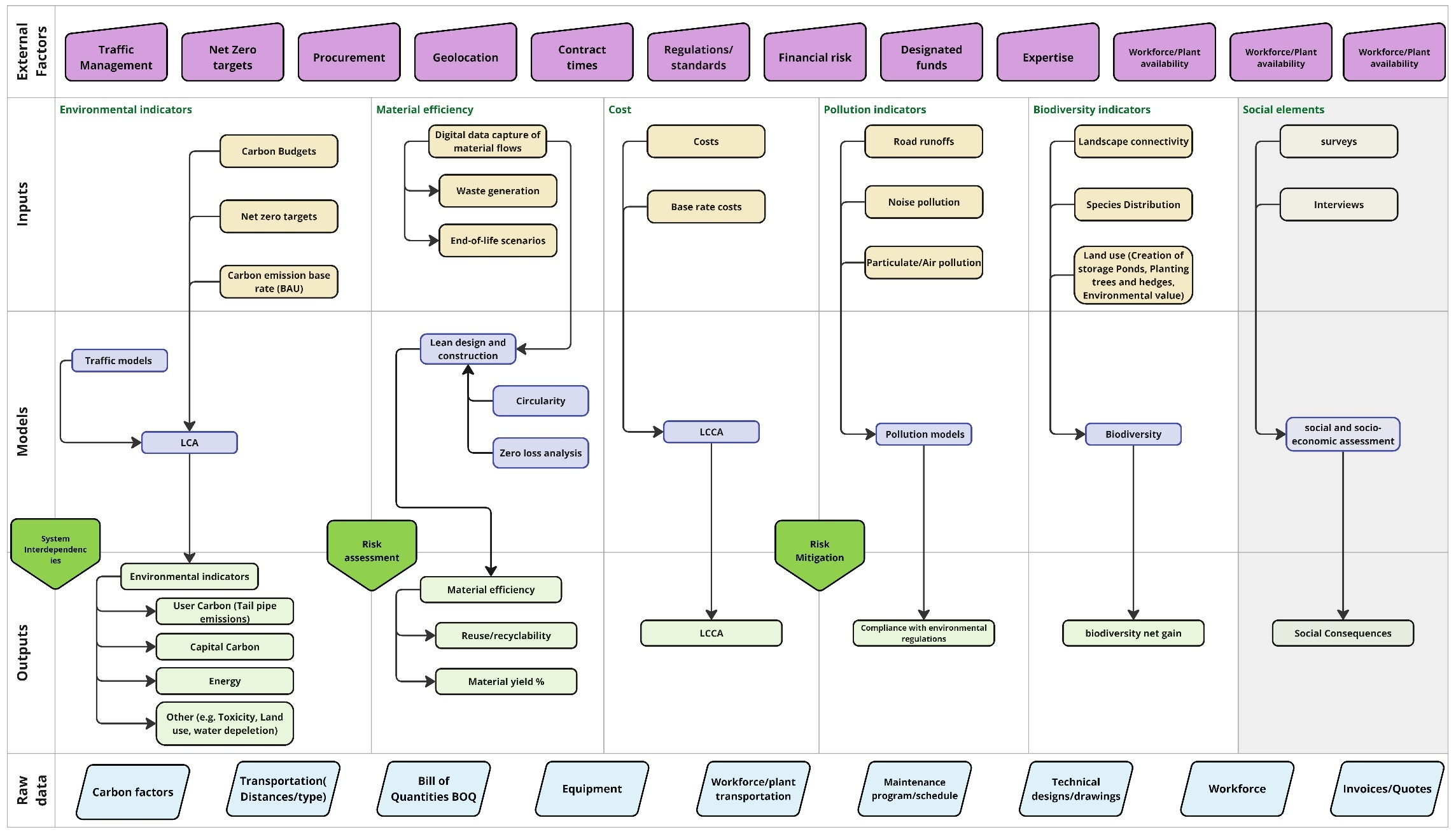
Figure 1. The Sustainability Module.
Methods and principles
The module is built on published standards rather than a bespoke method. Each one covers a different part of the problem.
| Standard or guidance | What it supplies |
|---|---|
| ISO 14040 and ISO 14044 | Life-cycle assessment principles, with modular life-cycle stages A1 to A5, B1 to B8, C1 to C4, and Module D |
| PAS 2080:2023, with the ICE guidance document | Carbon management across the whole value chain |
| EN 17472:2022 | Sustainability assessment of civil engineering works, setting requirements for environmental, economic and social performance |
| BS EN 15978 | The calculation framework |
| BS EN 15804 | Product-level declarations |
| RICS Whole Life Carbon Assessment (WLCA), second edition, effective 1 July 2024 | The assessment method, reporting conventions and boundary rules |
| IStructE, How to Calculate Embodied Carbon, third edition | Element-level measurement principles, data hierarchy, separate reporting of biogenic carbon and design efficiency, with SCORS for benchmarking |
| HM Treasury Green Book and DfT Transport Analysis Guidance, particularly TAG unit A3 | Environmental impacts and their monetisation |
Why the life-cycle stage codes matter
The A, B, C and D module codes are the standard way of saying where in an asset's life an impact falls: A covers product and construction, B covers use and maintenance, C covers end of life, and D covers benefits and loads beyond the system boundary.
Two assessments that report different totals are often measuring different stage ranges rather than disagreeing. Stating the stages is what makes results comparable.
Tools and models
Carbon tools and calculators
| Tool | Scope |
|---|---|
| Rail Carbon Tool (RSSB) | GB rail project carbon assessment |
| National Highways carbon tool | Road scheme construction, maintenance and operation |
| Environment Agency carbon planning tool | Earthworks, flood and water assets |
| Structural Carbon Tool version 3 (IStructE and Elliott Wood) | Structural element screening and SCORS rating |
Life-cycle assessment software
LCA software drawing on background life-cycle inventory data, such as SimaPro, OneClick and OpenLCA, together with their associated life-cycle inventories.
Operational and user carbon
Traffic and energy models, covering the carbon arising from operating the asset and from the journeys made on it.
Inputs: data sources
Material and product data
| Source | What it provides |
|---|---|
| Product EPDs and supplier declarations | Product-specific factors, obtained through procurement |
| UK sector average data | For example the Mineral Products Association and UK Concrete, BCSA and Steel for Life, and equivalent bodies for asphalt and precast |
| Built Environment Carbon Database (BECD) | Pan-industry UK material, component and project carbon data |
| Inventory of Carbon and Energy (ICE) database | Generic embodied carbon factors |
| Ecoinvent life-cycle inventory database | Background environmental data |
| Carbon factors | Recorded with the source tier per line |
Recording the source tier is a quality control
Carbon factors range from a supplier's own verified declaration down to a generic sector average. Recording which tier each figure came from, line by line, is what allows a reader to see how much of a total rests on solid data and how much on approximation.
Quantity and design inputs
Bill of quantities, material and product specifications, transportation distances, geolocation.
Construction and delivery inputs
Equipment and plant, workforce, programme and schedule, contact time, traffic management, procurement, maintenance, design life and residual life, replacement and intervention cycles.
Energy, fuel and grid data
| Source | What it provides |
|---|---|
| DESNZ UK greenhouse gas conversion factors | The 2026 set is current |
| UK grid decarbonisation projections | From DESNZ projections and NESO Future Energy Scenarios |
| Traffic flows, mode share and fleet composition | The basis for operational and user carbon |
| TAG data book appraisal values | Standard appraisal values |
| BCIS cost data | Capital cost, whole-life cost, and marginal abatement cost |
Grid projections change the answer
Operational carbon for an electrified asset depends on how the grid decarbonises over the asset's life, not on today's grid intensity. Using a projection rather than a current factor can reverse the ranking of two options.
Governance, target and constraint inputs
Net zero targets, regulations and standards, financial risks, designated funds, and stakeholder and local context inputs.
Outputs
Not written in the source
The Outputs section of this module in the source handbook contains only an unfinished editing note, not content. It indicates that outputs go to Risk Assessment and to the Detailed option assessment process, and nothing further.
Nothing has been written here in its place.
What can be stated from elsewhere in the handbook: the Risk Assessment module confirms that sustainability indicators such as carbon emissions, life-cycle impacts, material efficiency, biodiversity, and social or socioeconomic effects may either contribute to consequence scoring or be retained as supplementary decision criteria. See incorporating sustainability.
Dependencies on other modules and processes
The source lists two, without elaboration:
| Dependency | |
|---|---|
| Asset Registry | Supplies the asset information used to assess whole-life environmental, social and economic impacts. Sustainability records may be stored within, or linked to, the registry. |
| IMP: transport modelling and projections | Supplies the traffic flows, mode share and demand projections that operational and user carbon depend on. |
From the other modules' own dependency sections, two further relationships are documented:
- Asset Performance provides condition and performance information for whole-life impact assessment, and sustainability assessments may in turn influence performance targets, intervention thresholds and future performance requirements
- Resilience may receive complementary environmental and socioeconomic impact information from this module
Editing notes were left in the source
This section of the source handbook still contains unresolved author annotations, including instructions to promote a heading, notes that an entry was moved or de-duplicated, and a note that one tool was missing from a draft.
These are working notes rather than content, so they have not been reproduced. The substantive entries they refer to have been kept. The section would benefit from an editorial pass before publication.