

Asset Registry Module
The Asset Registry Module provides the authoritative repository of information about transport infrastructure assets. It is the foundation information resource on which the wider TPRAF framework depends.
Purpose
Its primary purpose is to ensure that information about assets is consistently identified, recorded, maintained and made available to the other DSP modules.
It holds information describing the asset base and the attributes attached to:
- individual assets
- asset groups
- asset systems
- wider transport networks
What it does not do
The registry records, it does not assess
The Asset Registry Module does not generally generate condition, performance, risk or other assessment outputs. Those information products are produced by other DSP modules and by associated organisational processes.
What the registry does is record, maintain, manage and provide access to them, so that current and historical asset information stays available for analysis, assessment and decision-making.
This distinction is the module's defining constraint. It is a system of record, not an analysis engine, and keeping that boundary clean is what allows every other module to trust what it reads.
The conceptual model
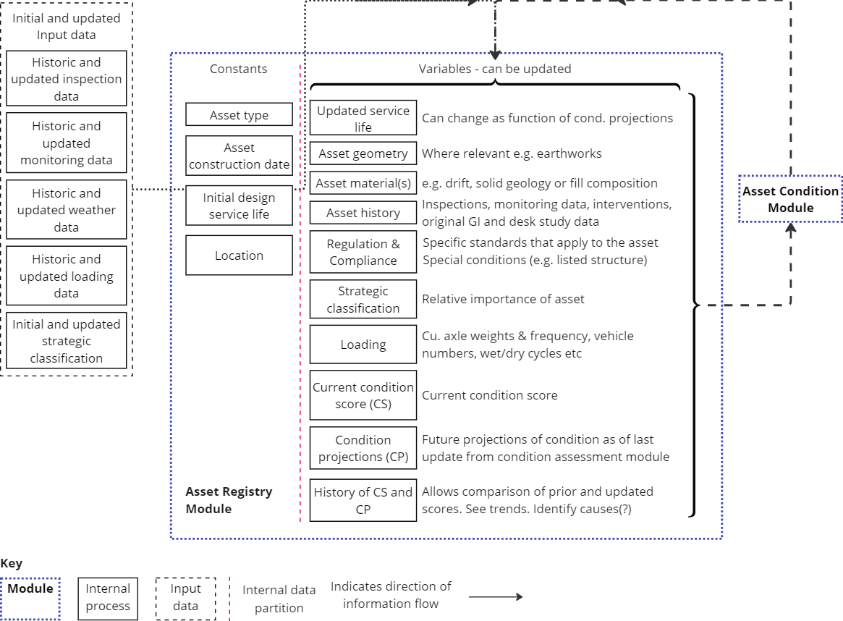
Figure 1. The Asset Registry Module, showing its constant and variable fields, its input data sources, and its exchange with the Asset Performance Module.
The diagram adds something the text does not state: the registry's fields are split into two partitions, and the split determines how each field behaves over time.
Constants
Set once, and true for the life of the asset.
| Field | |
|---|---|
| Asset type | What kind of asset it is |
| Asset construction date | When it was built |
| Initial design service life | The life it was designed for |
| Location | Where it is |
Variables, which can be updated
| Field | What it covers |
|---|---|
| Updated service life | Can change as a function of condition projections |
| Asset geometry | Where relevant, for example earthworks |
| Asset material or materials | For example drift, solid geology, or fill composition |
| Asset history | Inspections, monitoring data, interventions, original ground investigation and desk study data |
| Regulation and compliance | Specific standards that apply, and special conditions such as a listed structure |
| Strategic classification | Relative importance of the asset |
| Loading | Cumulative axle weights and frequency, vehicle numbers, wet and dry cycles |
| Current condition score (CS) | The current condition score |
| Condition projections (CP) | Future projections of condition, as of the last update from the condition assessment module |
| History of CS and CP | Allows comparison of prior and updated scores, to see trends and identify causes |
Why the last row matters most
Keeping the history of condition scores and projections, not just their current values, is what turns a registry into an evidence base. Without it you know an asset's condition. With it you know how fast it is changing, and whether the last projection turned out to be right.
Input data feeding the registry
Six streams feed in, and most are described as both historic and updated, meaning the registry accumulates rather than overwrites:
- Initial and updated input data
- Historic and updated inspection data
- Historic and updated monitoring data
- Historic and updated weather data
- Historic and updated loading data
- Initial and updated strategic classification
A naming inconsistency in the figure
The diagram labels the module it exchanges data with the "Asset Condition Module". Elsewhere the same module is called Asset Performance. They are the same thing. See the note on module naming.
Questions answered
The module is designed to answer six families of question.
Asset identification
- What assets exist within the network?
- Where are assets located?
- How are assets identified, referenced and classified?
- How are assets grouped into asset types, asset groups, asset systems and networks?
Asset definition
- What is the purpose and function of each asset?
- What are the key characteristics and attributes of each asset?
- What dimensions, construction details and other defining information are associated with the asset?
- Who owns, manages or is responsible for the asset?
Asset information
- What information is currently available for the asset?
- What inspection, monitoring, condition, maintenance, performance and risk information is recorded for the asset?
- What historical information exists for the asset?
- What documents, records and supporting information are associated with the asset?
- What information is missing, incomplete or requires improvement?
The last question is the unusual one
Most registries answer what is known. This one is also expected to answer what is not known. A recorded gap is actionable; an unrecorded gap silently weakens every assessment built on top of it.
Asset relationships
- How does the asset relate to other assets?
- Which asset system does the asset belong to?
- What dependencies or interactions exist between assets?
- What other infrastructure, services or operations are associated with the asset?
Information management
- How is asset information created, maintained and updated?
- Where is asset information stored?
- Who is responsible for maintaining asset information?
- How can asset information be retrieved, shared and used?
- What information management standards, processes and controls are applied?
Information provision
What information is available to support each of:
- Asset performance assessment
- Risk assessment
- Maintenance, renewal and investment planning
- Lifecycle management and decision-support activities
Methods and principles
The module establishes the principles through which asset information is identified, structured, maintained and governed across the asset lifecycle, so that it stays consistent, traceable, accessible and fit for use.
Asset identification
Asset identification is the foundation on which all other asset information is organised. Consistent identification and referencing ensure information can be uniquely associated with the correct asset throughout its lifecycle.
- All assets should be uniquely identified and recorded within the registry
- A consistent referencing approach should be applied across the asset base
- Each asset should have enough descriptive information to be distinguished from other assets and unambiguously located within the wider transport system
Asset classification
- Classification should allow assets to be grouped by function, characteristics, ownership, operational significance or other organisational requirements
- Assets should be classified using a consistent and documented framework
- The structure should support management, reporting, analysis and decision-making at multiple organisational levels
Asset hierarchy
- Assets should be organised within a logical hierarchy
- The hierarchy should support navigation from individual assets up to asset groups, asset systems, networks and portfolios
- It should show how assets contribute to wider operational and business functions
Asset system representation
- The registry should capture relationships between assets
- Where appropriate it should identify dependencies, interfaces and interactions between assets, asset systems and associated infrastructure
- It should support understanding of how assets contribute to delivering transport services and network functions
Information management
The registry should act as the authoritative source of asset information, managed across its full lifecycle:
| Stage | |
|---|---|
| Creation | Information is first produced |
| Collection | It is gathered into the registry |
| Validation | It is checked before being relied on |
| Storage | It is held |
| Maintenance | It is kept correct |
| Update | It is revised as things change |
| Archiving | It is retained once superseded |
| Disposal | It is removed when no longer of value |
These processes should ensure data remains accessible, traceable and fit for purpose.
Data quality
Asset information should be subject to appropriate quality controls, managed against six criteria:
| Criterion | The question it answers |
|---|---|
| Accuracy | Is it right? |
| Completeness | Is any of it missing? |
| Consistency | Does it agree with itself and with other records? |
| Timeliness | Is it current enough to use? |
| Traceability | Can you tell where it came from? |
| Relevance | Does it bear on the decision at hand? |
Known limitations, uncertainties and gaps should be recorded where appropriate.
Information integration
Asset information is often generated by multiple organisations, systems and business processes across the asset lifecycle. Integration ensures those sources can be connected, related and interpreted consistently.
Information may originate from:
- Inspection
- Condition assessment
- Monitoring
- Maintenance
- Renewal
- Operational activities
- Risk assessment
- External systems
The registry should provide mechanisms for linking these sources to the relevant assets.
Information governance
Effective asset management depends on clear ownership, responsibility and accountability for information. Governance arrangements should specify:
| Information ownership | Who the information belongs to |
| Information stewardship | Who looks after it day to day |
| Update responsibilities | Who is obliged to keep it current |
| Access permissions | Who may read and change it |
| Information standards | What form it must take |
The purpose is to ensure information remains reliable and trusted.
Lifecycle information management
The registry should maintain information throughout the life of an asset, keeping it available to support planning, operation, maintenance, monitoring, renewal, replacement and decommissioning.
Historical information should be retained where it provides value for future decision-making.
Single source of truth
The principle that ties the rest together
The Asset Registry should function as the primary reference source for asset information. Other modules may generate or analyse asset-related information, but the registry provides the controlled repository through which that information is recorded, maintained and made available to the wider framework.
It therefore provides the structured information foundation required for asset performance assessment, risk assessment, lifecycle planning, maintenance planning, renewal planning and investment decision-making.
Tools and models
The module is typically supported by a combination of information systems, data repositories and information-management frameworks. Grouped by what they do:
| Group | Typical tools |
|---|---|
| Systems of record | Asset Management Information Systems, Enterprise Asset Management Systems, Asset Databases, Data Repositories |
| Location and spatial | Geographic Information Systems (GIS), Location Referencing Systems, Asset Mapping and Visualisation Tools |
| Structure | Asset Classification Frameworks, Asset Hierarchy Models, Asset System Models |
| Documents | Document and Records Management Systems |
| Data management and governance | Data Management Systems, Information Governance Frameworks, Data Quality Frameworks, Metadata Frameworks, Data Integration Services |
| Reporting | Information Dashboards and Reporting Tools |
Capability matters more than product
The selection and implementation of specific tools will vary between organisations. What does not vary is the capability required: consistent identification, classification, storage, maintenance, retrieval and governance of asset information.
An organisation with an equivalent in-house system does not need to replace it.
Inputs: data and information
The module draws on internal and external sources to establish, maintain and update the asset information base.
Asset definition data
Asset identifiers, classifications, hierarchy information, ownership information, location information, dimensions and geometry, attributes and characteristics, construction information, installation and commissioning records.
Inspection and survey data
Inspection records, survey information, site investigation records, inventory surveys, asset verification surveys, asset condition surveys.
Monitoring data
Monitoring records, instrumentation outputs, operational monitoring data, performance monitoring data, environmental monitoring data.
Maintenance and operational data
Maintenance histories, work records, repair records, renewal records, operational records, incident records, failure records, service disruption records.
Performance and risk data
Asset condition information, asset performance information, asset criticality information, risk assessment outputs, risk register information, resilience assessment outputs.
Financial and commercial data
Asset valuation information, capital expenditure records, maintenance expenditure records, whole-life cost information, business case information, investment programme information.
External data sources
Geographic and spatial datasets, environmental datasets, climate and weather records, third-party asset information, utility and service information, regulatory and statutory information.
Documentary sources
As-built records, design records, technical reports, drawings and specifications, historical records, monitoring reports, inspection reports.
Data governance applies to all of it
All data sources should be managed in accordance with organisational information management requirements, so that asset information remains accurate, consistent, traceable and suitable for decision support.
Outputs
Because the registry does not generate condition, performance, risk, resilience or sustainability assessments, its outputs are the asset information products, records, datasets and information views made available to other modules and users.
Asset structure information
Asset inventories, asset records, asset classifications, asset hierarchies, asset system definitions.
Asset information records
Asset location datasets, attribute datasets, condition records, performance records, monitoring records, maintenance records, renewal records, risk records, valuation records.
Information products and reporting outputs
Asset management datasets, asset maps and spatial datasets, asset information reports, information extracts, information visualisations, and asset-related drawings, documents and supporting records.
Dependencies on other modules and processes
The Asset Registry supports all other DSP modules by providing the asset information they need. In turn, information generated by those modules is fed back into the registry to support future analysis.
| Module | What it takes from the registry | What it returns |
|---|---|---|
| Asset Performance | Asset definitions, classifications and relationships | Condition, performance, inspection, monitoring and deterioration records |
| Risk Assessment | Asset information used to identify and assess risks | Risk scores, risk categories, risk records, criticality information |
| Resilience | Asset and system information | Resilience assessments, linked to the recorded assets and systems |
| Sustainability | Asset information for whole-life impact assessment | Sustainability information and associated records |
| Risk Mitigation | Asset, condition, performance and risk information | Recommended interventions, linked to the relevant assets |
| System Interdependencies | Asset relationships, dependencies and system boundaries | Enhanced and updated relationship records |
Two of these are worth drawing out.
Asset Performance is stored within or linked to the registry
Condition and performance records are held in, or linked from, the registry so that both current and historical records exist. That is what enables changes, trends, and rates of deterioration or improvement to be assessed over time.
System Interdependencies depends on it most heavily
Asset relationships, dependencies and system boundaries are themselves a key part of what the registry holds, so that module both draws on the registry more than the others and writes back to improve it.
External processes
Beyond the DSP, the registry supports:
- Asset management planning
- Maintenance planning
- Renewal planning
- Investment planning
- Programme delivery
- Performance monitoring
- Reporting and assurance
- Regulatory compliance
- Business case development
- Information governance
The Asset Registry therefore functions as the information foundation of the DSP, providing the common environment through which information is exchanged between modules, maintained through time, and used in wider organisational processes.