

Overview of decision support elements
The DSP is built from two kinds of element, and almost everything in this handbook is one or the other.
| Element | What it is | Defined in |
|---|---|---|
| Process flow | A stage of the decision cycle. There are six. | Processes |
| Module | A set of tools, models or methods that a stage draws on. There are seven. | Modules |
The six process flows are interconnected through a series of modules and established or tailored processes. That phrasing matters: the modules are not bolted on beside the stages, they are the connective tissue between them.
The master diagram
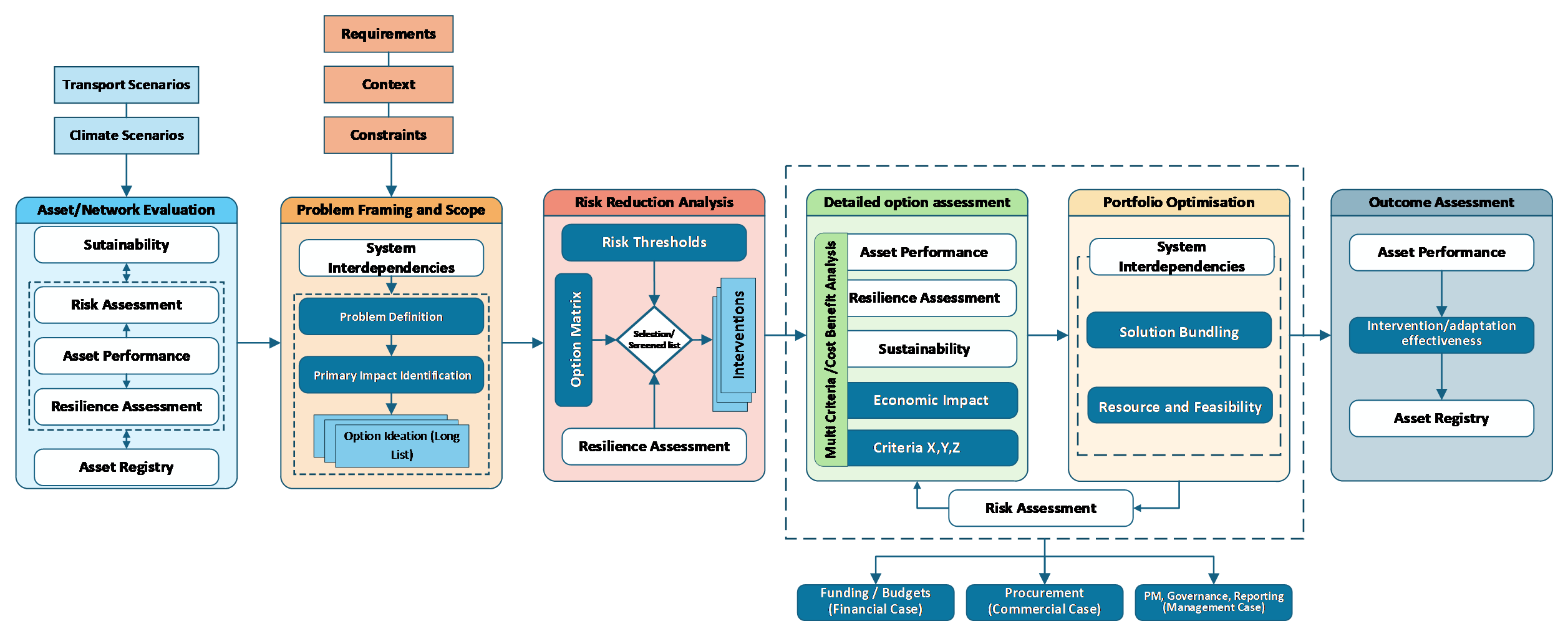
Figure 1. Decision Support Process: key stages, modules and process flows.
This single diagram carries more detail than the surrounding text, so it is worth reading closely. Three things it shows that the prose does not state.
1. Which modules each stage actually uses
The modules named inside each coloured stage are the ones that stage draws on. Read across, that gives a usage matrix:
| Module | Evaluation | Framing | Risk reduction | Option assessment | Portfolio | Outcome |
|---|---|---|---|---|---|---|
| Asset Registry | Yes | Yes | ||||
| Asset Performance | Yes | Yes | Yes | |||
| Risk Assessment | Yes | Yes | ||||
| Resilience | Yes | Yes | Yes | |||
| Sustainability | Yes | Yes | ||||
| System Interdependencies | Yes | Yes |
Two patterns stand out. Asset and network evaluation is the heaviest user, pulling on five of the six, which is consistent with its job of establishing the baseline. And Asset Registry appears at the two ends only, at evaluation and again at outcome assessment, which is what you would expect of a system of record: read at the start, written back to at the finish.
2. What enters the process from outside
Two sets of external inputs feed the first two stages, and they are of different kinds.
| Feeding | Inputs | What they are |
|---|---|---|
| Asset/Network Evaluation | Transport Scenarios, then Climate Scenarios | The modelled futures the baseline is tested against, supplied by the IMP |
| Problem Framing and Scope | Requirements, then Context, then Constraints | The decision's boundary conditions, supplied by the organisation and its stakeholders |
3. Where the process delivers to
Stages four and five sit inside a single dashed boundary, and three outputs leave the bottom of it:
- Funding and Budgets, labelled the Financial Case
- Procurement, labelled the Commercial Case
- PM, Governance and Reporting, labelled the Management Case
These are Treasury Five Case Model names
Financial Case, Commercial Case and Management Case are three of the five cases in the HM Treasury business case standard. Their appearance here shows exactly where the DSP is designed to hand over to the UK public-sector approval process, which is the practical meaning of the claim that it supports an Outline Business Case.
The diagram is the only place this connection is made. The prose does not mention it.
The feedback loop
The diagram shows one explicit loop. A Risk Assessment box sits below stages four and five, taking input from Portfolio Optimisation and feeding back into Detailed option assessment.
The reason is that bundling changes risk. A set of interventions combined into a portfolio does not carry the sum of the risks each carried alone, so once options are bundled the risk position has to be assessed again and the option assessment revisited.
What this chapter covers
| Page | What you will find |
|---|---|
| Modules | What a module is, and all seven described |
| Processes | What a process is, and all six described |
| Data & Tools | How modules, processes, data, tools and outputs interact |
| Input & Output | The generic input-output logic and data schema |
| Methods & Principles | Core methods, principles and tool types used across the DSP |
Three sections are awaiting source text
Data & Tools, Input & Output, and Methods & Principles are headings in the source handbook with nothing written beneath them. Nothing has been written in their place.