

Asset Performance Module
The Asset Performance Module evaluates whether assets continue to meet required performance objectives, service levels and operational requirements, using condition, capacity and serviceability information as evidence.
Purpose
The module transforms inspection, monitoring and assessment data into information that supports maintenance planning, renewal planning, investment decisions, risk assessment and wider asset management activities.
It generates, the registry stores
The Asset Performance Module does not primarily act as a repository. It generates and updates performance-related information, which is then recorded within the Asset Registry and used by other DSP modules.
This is the mirror image of the registry's constraint. Together the two form a clean split: one module works out what is true, the other keeps it.
It therefore provides the evidence base needed to understand current performance, predict future performance, and identify the need for intervention.
The conceptual model
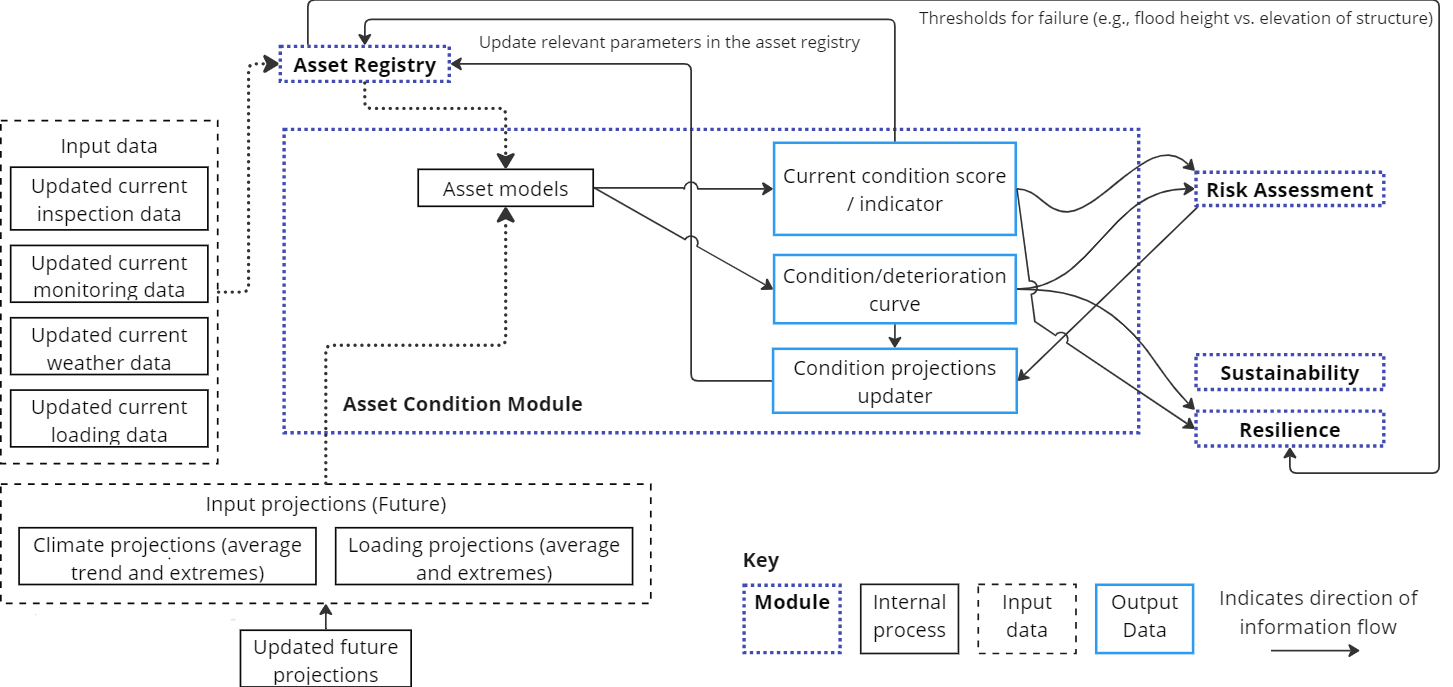
Figure 1. The Asset Performance Module, showing its inputs, its three information products, and the modules it feeds.
The diagram shows the module's internal mechanics, which the prose does not set out.
One internal process, three products
At the centre sit the asset models. They consume the registry's asset information along with current and projected data, and produce three distinct things:
| Product | What it tells you |
|---|---|
| Current condition score or indicator | Where the asset stands today |
| Condition and deterioration curve | The shape of how it is declining |
| Condition projections updater | Revised forward projections, written back to the registry |
The third is a process rather than a number, and that is the point. Projections are not computed once. They are updated as new evidence arrives, and the revision flows back into the registry.
Two kinds of input
| Group | Contents |
|---|---|
| Current data | Updated inspection data, monitoring data, weather data, loading data |
| Future projections | Climate projections and loading projections, each covering average trend and extremes |
Average trend and extremes, not just averages
Both projection inputs are specified as covering the average trend and the extremes. An asset can be comfortable against a mean and fail against a peak, so a deterioration model driven by averages alone would systematically understate risk.
The diagram also carries a worked note on what a failure threshold looks like in practice: flood height against the elevation of the structure.
Where its outputs go
The three products feed three modules directly: Risk Assessment, Sustainability and Resilience, alongside the write-back to the registry.
Questions answered
Current asset performance
- Is the asset continuing to perform its intended function?
- What is the current condition, serviceability and capacity of the asset?
- Have performance levels improved, remained stable or deteriorated?
- What defects, deterioration mechanisms or performance issues are present?
- Does the asset remain fit for its intended purpose?
Performance requirements and service levels
- What levels of service is the asset required to deliver?
- What performance objectives, targets and thresholds apply?
- Is the asset currently meeting those requirements?
- What performance gaps exist between required and actual performance?
Deterioration and future performance
- How is the asset expected to deteriorate over time?
- What are the likely future condition and performance states?
- When are performance thresholds likely to be reached?
- What is the remaining useful life of the asset?
Performance evidence from monitoring and assessment
- What information is available from inspections, monitoring and assessments?
- What trends can be identified from historical condition and performance information?
- What additional monitoring or assessment may be required?
- What uncertainty exists in the available performance information?
Intervention triggers and requirements
- Has asset performance deteriorated to a level that requires action?
- Which performance thresholds or trigger levels have been reached?
- When is intervention likely to be required?
- What are the consequences of delaying intervention?
- What information should be provided to support subsequent intervention decisions?
Decision support
- Which assets are deteriorating most rapidly?
- Which assets are approaching critical performance thresholds?
- Which assets require increased monitoring, maintenance or renewal?
- What information is required to support risk assessment and prioritisation?
- What information is required to support maintenance, renewal and investment planning?
Two different prioritisation questions
"Deteriorating most rapidly" and "approaching critical thresholds" do not give the same answer. A sound asset declining fast may still have years in hand; a stable one may already be at its limit. Asking both is what prevents a single ranking from hiding one of the two.
Methods and principles
The module converts observations, inspection findings, monitoring records and operational information into performance-based evidence.
Data collection for performance evaluation
- Assessment should be informed by inspection, monitoring, survey and operational information
- Performance information should come from both routine and specialist assessment activities where appropriate
- Monitoring should be proportionate to the importance, condition, criticality and risk profile of the asset
Performance evaluation
- Condition should be assessed using a structured and repeatable methodology
- Assessment should identify defects, deterioration and degradation mechanisms
- Performance should be evaluated against defined objectives, service levels, thresholds and requirements
- Assessment should consider both the physical state of the asset and its ability to continue delivering the required function
- Assessments should be possible at component, asset, asset-system and network levels
Physical state and function are not the same test
An asset can be visibly degraded yet still doing its job, or look sound yet no longer meet the service level now required of it. The module is specified to check both.
Trend and deterioration assessment
- Historical condition and performance information should be retained and used to identify trends
- Assessments should consider changes over time rather than relying solely on single-point observations
- Deterioration mechanisms should be identified and evaluated where possible
- The rate of deterioration should be considered when assessing future performance and intervention requirements
Forecasting and threshold management
Future condition and performance should be forecast where appropriate. Forecasts may draw on:
- Deterioration models
- Trend analysis
- Historical records
- Monitoring information
- Expert judgement
The stated aim is that forecasting should support proactive rather than reactive asset management.
Assessment should identify relevant thresholds, trigger levels and intervention points, and exceeding a defined threshold should initiate review, reassessment or intervention as appropriate.
Continuous improvement
- Inspection, monitoring and intervention outcomes should be reviewed and used to refine future assessment approaches
- New information should be incorporated to improve forecasting accuracy
- Performance information should be linked to the Asset Registry and support the other DSP modules
Tools and models
| Group | Tools | What they do |
|---|---|---|
| Inspection and condition assessment | Inspection frameworks, condition assessment frameworks, condition grading systems, condition classification systems, condition scoring systems, defect assessment frameworks, asset condition reporting systems | Structured approaches for assessing condition, recording defects and evaluating serviceability |
| Monitoring systems | Condition, performance, structural, environmental, groundwater and deformation monitoring systems, instrumentation and sensor systems, survey monitoring systems | Information on asset behaviour, condition changes, performance trends and deterioration mechanisms |
| Assessment and analysis models | Deterioration models, degradation models, trend analysis techniques, forecasting models, reliability models, capacity assessment approaches, asset performance models | Interpretation of current performance and prediction of future condition and serviceability |
| Performance management frameworks | Levels of Service (LOS) frameworks, performance measurement frameworks, performance indicator frameworks, KPI frameworks, performance target frameworks, benchmarking frameworks, continuous improvement frameworks | Evaluation of performance against organisational objectives and service requirements |
| Decision support tools | Risk-informed assessment tools, prioritisation frameworks, whole-life cost assessment tools, decision support systems, asset management systems, performance dashboards and reporting tools, predictive maintenance tools | Translating performance information into maintenance, renewal and investment decisions |
The selection of specific tools should reflect the asset type, available data, organisational requirements and desired level of analytical sophistication.
Inputs: data sources
Asset information
Asset identifiers, classifications, hierarchy information, characteristics and attributes, dimensions and geometry, location information, asset system relationships, criticality information.
Asset condition and performance information
Condition observations, condition scores, condition classifications, defect records, deterioration records, degradation information, serviceability information, operational performance information.
Inspection, assessment and survey information
Routine and principal inspection records, specialist inspection records, survey records, asset assessment reports, site investigation records, technical assessment reports.
Monitoring information
Condition monitoring records, performance monitoring records, instrumentation records, structural monitoring information, environmental monitoring information, operational monitoring information.
Maintenance and operational information
Maintenance records, repair records, renewal records, operational performance information, service disruption records, failure records, incident records.
Performance criteria and thresholds
Service level requirements, operational requirements, performance targets, performance thresholds, trigger levels, regulatory and statutory requirements.
Risk and resilience information
Risk assessment outputs, asset criticality information, vulnerability information, resilience assessment outputs.
Environmental and external information
Environmental conditions, climate and weather data, hazard information, demand forecasts, asset utilisation information, stakeholder requirements and expectations.
Current and historical, together
Many of these sources hold both current and historical records, and assessments should use both. Historical records are what make trend analysis, deterioration assessment and forecasting possible at all.
All information should be subject to quality assurance, so that assessments rest on accurate, consistent and traceable evidence.
Outputs
The module produces evidence describing current performance, historical performance, future performance and intervention needs.
Condition and performance measures
Asset condition scores, condition grades, condition classifications, performance scores, performance indicators, serviceability measures, capacity measures, reliability measures, availability measures, operational performance measures.
Assessment outputs
Asset condition assessments, performance assessments, defect assessments, deterioration assessments, degradation assessments, capacity assessments, serviceability assessments.
Trend and monitoring information
Condition trends, performance trends, deterioration trends, monitoring summaries, historical asset-performance records, asset-performance baselines, benchmarking information.
Forecasting outputs
Deterioration forecasts, condition forecasts, performance forecasts, remaining life estimates, future serviceability projections, future performance scenarios, forecast threshold exceedances.
Threshold and trigger outputs
| Output | |
|---|---|
| Trigger exceedance notifications | A threshold has been crossed |
| Performance threshold assessments | How the asset stands against its thresholds |
| Intervention trigger recommendations | What the exceedance should prompt |
| Assets approaching critical thresholds | Early warning, before exceedance |
| Assets requiring reassessment | Where the evidence is no longer good enough |
Decision-support outputs
Performance gap assessments, prioritised performance concerns, maintenance need indicators, renewal need indicators, performance-related investment needs, plus information supporting risk assessment, resilience assessment, sustainability assessment and risk mitigation activities.
Reporting outputs
Performance reports, performance dashboards, performance summaries, condition reports, monitoring reports, performance datasets, and asset-performance updates for the Asset Registry.
Dependencies on other modules and processes
| Module | The exchange |
|---|---|
| Asset Registry | Supplies asset identifiers, classifications, attributes, relationships and historical records. Receives condition scores, assessments, deterioration trends and performance measures back. |
| Risk Assessment | Receives condition information, deterioration forecasts, performance trends, capacity constraints and threshold exceedances, all feeding likelihood and consequence. Returns identification of assets needing more monitoring or analysis. |
| Resilience | Uses condition and performance information to understand response to, and recovery from, disruption. May identify performance vulnerabilities needing further investigation here. |
| Sustainability | Uses condition and performance information for whole-life environmental, social and economic impact. May influence performance targets, intervention thresholds and future requirements. |
| Risk Mitigation | Uses condition assessments, deterioration forecasts, performance trends and threshold exceedances as evidence for the selection and timing of interventions. |
| System Interdependencies | Uses performance information to understand how deterioration or failure in one asset affects connected assets, systems, users and networks. Critical dependencies may reshape monitoring and forecasting priorities here. |
Most of these dependencies run both ways
Risk Assessment, Resilience, Sustainability and System Interdependencies all both consume this module's outputs and send information back that changes what it should assess next. The module is a participant in a loop, not a one-way supplier.
External processes
Inspection programmes, monitoring programmes, maintenance planning, renewal planning, investment planning, asset management planning, business case development, performance reporting, regulatory compliance, and assurance and governance processes.
The Asset Performance Module therefore functions as the primary mechanism through which asset condition, serviceability and performance are evaluated, providing the evidence for risk-informed, evidence-based decision-making across the wider DSP.