

General overview
The DARe Integrated Modelling Platform (IMP) couples multiple models and datasets together to simulate how climate affects transport infrastructure in the UK, covering both the network as it stands today and the decarbonised networks being planned for the future.
Those simulations serve two purposes: exploring what future transport scenarios would look like, and measuring how resilient each one turns out to be once a real hazard is thrown at it.
Where the framework came from
The framework is the product of extensive collaboration across the DARe modelling teams. The problem they set out to solve was integration. Climate data, hazard models, transport networks and urban-development-driven demand had all been modelled well in isolation, but rarely joined up end to end.
What emerged couples two things that had not previously been combined at this resolution: cutting-edge transport models, such as agent-based models, and high-resolution simulations of future climate.
The framework
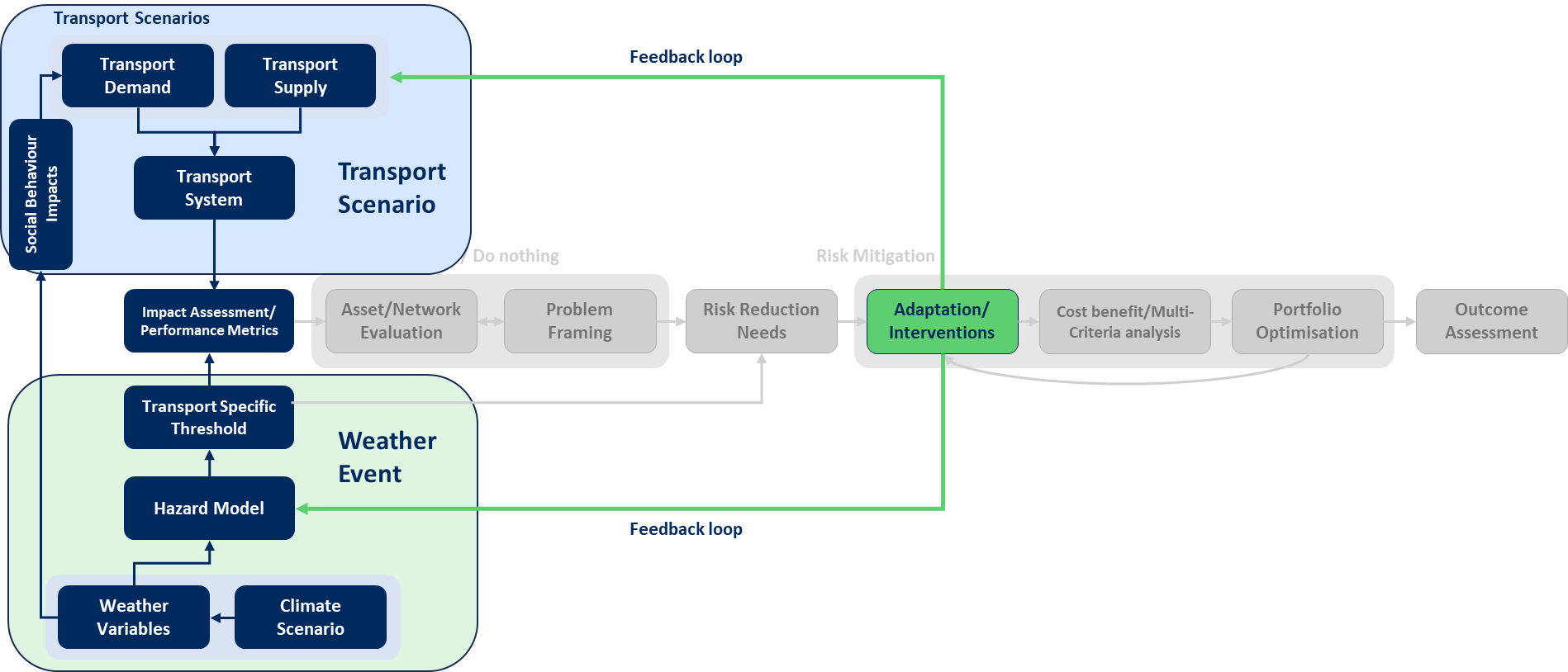
Figure 1. The IMP conceptual framework. The weather event component is shown in green and the transport scenario component in blue.
Two components drive everything:
| Component | Shown as | What it establishes |
|---|---|---|
| Weather event | Green box | What the hazard is, where it lands, and how severe it gets over time |
| Transport scenario | Blue box | Who is travelling, on what network, and how they behave |
They are modelled independently, then intersected. That intersection is what turns "this rainfall event floods these roads" into "these journeys fail, and here is what that costs."
The green arrows on the diagram are the part that makes it a decision tool rather than an assessment. Once an adaptation measure is chosen, it feeds back into the hazard model and the transport scenario, and the whole framework runs again.
Why it is useful
Joining the models up this way supports two things that isolated models cannot do on their own:
- Finding vulnerabilities. Planners and policymakers can see where the system actually fails, and develop targeted interventions that enhance system-wide resilience.
- Prioritising investment. Pinpointing the critical links in a network shows which failure points are most disruptive under climate stress, and therefore which investments buy the most resilience per pound.
The result is a clearer picture of the costs and trade-offs attached to both impacts and adaptation options.
Where to go next
The two components are described in Weather event and Transport scenario. What happens where they meet is covered in Weather × transport.