

Architecture
The orchestration platform is split across three servers, with code pulled from a public repository and users accessing two points in the system.
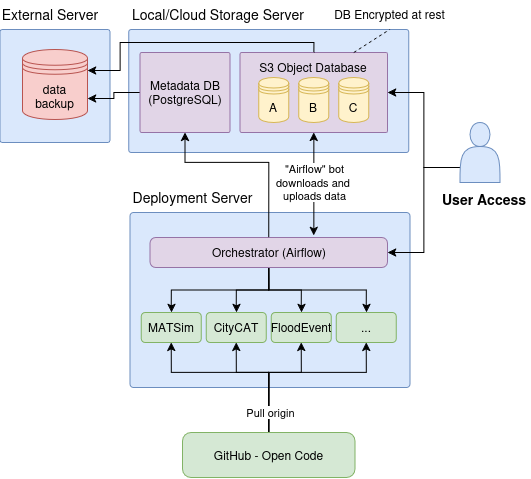
Figure 3. Orchestration architecture.
The three servers
| Server | Holds |
|---|---|
| Deployment Server | The Orchestrator (Airflow) and the models it drives: MATSim, CityCAT, FloodEvent and others |
| Local or Cloud Storage Server | The Metadata DB (PostgreSQL) and the S3 Object Database |
| External Server | A data backup, receiving copies from both stores |
Separating compute from storage
The models run in one place and their data lives in another. That separation is what makes the storage layer swappable, and it is why the same mechanism works against either a locally hosted object store or cloud storage. See data storage.
How data moves
An Airflow bot downloads and uploads data between the Deployment Server and the storage server. Models running on the deployment side fetch their inputs and write their outputs through it, rather than reading and writing storage directly.
Where code comes from
The Deployment Server pulls from a GitHub repository of open code. The platform itself is published at DAReHub/DAReflow.
This is the version-control route in practice: what runs on the deployment server is whatever the repository says it should be. See version control.
How users interact
The diagram shows two user entry points, not one:
| Entry point | Purpose |
|---|---|
| The Orchestrator | Configuring and running DAGs |
| The S3 Object Database | Retrieving model outputs directly |
Why direct data access matters
Researchers across DARe need model outputs without needing to operate the models.
Giving them a route to the object store that does not pass through Airflow is what makes the outputs genuinely shared rather than locked behind the pipeline that produced them.
Security
The diagram annotates the object database as encrypted at rest, and both the metadata database and the object store replicate to an external backup server.
Noted from the figure
The encryption and backup arrangements appear in the architecture diagram but are not described in the handbook's text. They are recorded here because they are operationally significant, and should be written up properly in the source.